Electrons and Photons: The 1927 Solvay Conference and the Compounding of Ideas
Sections
The photograph is not much to look at. Twenty-nine people are arranged in three rows outside a building in Brussels, dressed for a cold October morning in 1927: dark suits, stiff collars, a few watch chains, one fur collar. No one is doing anything. There is no blackboard, no instrument, no machine anywhere in the frame — nothing a visitor from the present would recognize as the future. A stranger flipping past it would file it with every other old group portrait, a faculty or a firm or a funeral party, and move on.
Seventeen of the twenty-nine either held a Nobel Prize or would go on to win one. The woman near the middle held two, in two different sciences, and remains one of a small handful of people who ever have. In the two or three years before the shutter opened, several of the men in the picture — some still in their twenties — had built a new mechanics for matter and light so accurate that, within its tested domain, a century of experiments has not caught it in an error, and so strange that its own authors could not agree on what it was saying. That disagreement is what they had come to Brussels to have.
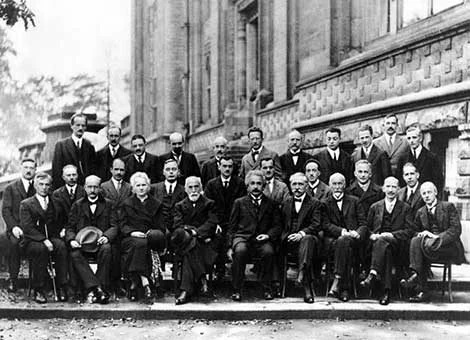
This essay is about that photograph, and about a question it poses more sharply than almost any image I know. How can a meeting of fewer than thirty people change what a whole civilization can do? The Fifth Solvay Conference is a good specimen to think with — not because the people in it were geniuses, since many gatherings of geniuses produce nothing, but because we can trace, with unusual clarity, how a set of abstract arguments in one room compounded over a century into a great deal of the machinery we now live inside. The tracing is the interesting part, and it is less tidy than the legend.
Why the room was convened
The conference existed because a chemist had made a fortune and chose to spend some of it convening the people at the frontier of a field that was not his.
Ernest Solvay was a Belgian industrialist who, in the 1860s, worked out a cheaper way to make sodium carbonate — soda ash, the white powder behind glass, soap, and paper — from ammonia and brine. The process made him very rich. He had his own amateur theories of matter and energy, and he used his money to gather the leading physicists of Europe to hear them; the first Solvay Council met in 1911, chaired by the Dutch physicist Hendrik Lorentz, with a young Einstein among the guests. Solvay’s own ideas went politely nowhere. The format did not. It turned out that assembling two dozen of the people most responsible for a field, around a single hard question, with nothing to sell, was worth more than any patron’s pet theory.
The fifth meeting opened on 24 October 1927 and took its subject as électrons et photons — electrons and photons. The phrase is sometimes glossed as “the two things everything is made of,” which is false: ordinary matter also contains quarks bound inside protons and neutrons, and light is not a material that objects are built from. Electrons and photons were something more specific — the principal carriers of matter’s chemical behavior and of the electromagnetic interaction, and the two entities whose double life as both wave and particle had made classical physics untenable. They were where the crisis lived, which is why the meeting was organized around them.
The 1927 sessions were held at the Institute of Physiology in Brussels’s Parc Léopold, the last Solvay Council held there. The program was a sequence of formal reports, and those reports are a cleaner introduction to the room than any list of names. William Lawrence Bragg opened on the reflection of X-rays from crystals — the method, devised with his father, that let physicists read atomic arrangements directly, and for which he remains the youngest-ever physics laureate. Arthur Compton followed on the places where experiment refused to fit the classical electromagnetic theory of radiation; his own scattering experiment a few years earlier, in which X-rays bounced off electrons like billiard balls carrying momentum, had been among the most decisive evidence that light comes in particulate quanta. Louis de Broglie, an aristocrat who had come to physics late through his brother’s X-ray laboratory, reported on the new “dynamics of quanta” that had begun with his 1924 proposal: if light waves can behave like particles, particles like electrons ought to behave like waves. Max Born and Werner Heisenberg presented the matrix version of the new quantum mechanics; Erwin Schrödinger presented the wave version, which had been shown, to general relief, to be mathematically equivalent to it.
Around these speakers sat the rest of the field. Niels Bohr, whose Copenhagen institute was the discipline’s center of gravity and whose 1913 model had first quantized the atom. Max Planck, who had begun everything in 1900 by proposing that energy comes in discrete units. Marie Curie, the room’s link to the previous revolution, radioactivity. Wolfgang Pauli, whose exclusion principle explained why electrons stack into shells and therefore why the periodic table has the shape it does. Paul Dirac, twenty-five, who had just built the “transformation theory” unifying the matrix and wave pictures and who within a year would write down a relativistic equation for the electron that implied the existence of antimatter. Hendrik Kramers, Bohr’s chief collaborator, whose work on how light disperses through matter fed directly into the new mechanics; Paul Ehrenfest, trusted by every camp; Peter Debye, who had turned quantum ideas onto the shapes and heat capacities of molecules; Owen Richardson, who had explained how hot metals boil off electrons; Charles Wilson, whose cloud chamber made the tracks of individual particles visible. Lorentz, aging and universally trusted, held the chair. It was, by almost any measure, the most concentrated collection of physical insight ever gathered for a working meeting — and, as it turns out, concentration alone is not what made it matter.
A formalism ahead of its meaning
What charged the room was a situation rare in the history of science.
By October 1927 the new quantum mechanics was not a finished theory. Its nonrelativistic core had largely taken shape and was extraordinarily successful — it gave the spectrum of hydrogen, the behavior of electrons in fields, the logic of the periodic table — but major formal problems were still open. Dirac’s relativistic electron equation was a year away; a quantum theory of the electromagnetic field was embryonic; how spin and the act of measurement fit the framework was unsettled; quantum field theory barely existed. What had arrived was a powerful predictive formalism whose reach was still being mapped, not a closed book.
And yet the argument at Solvay was not mainly about the missing mathematics. It was about what the mathematics already in hand actually meant. The theory’s central object is the wavefunction, ψ, and Schrödinger’s equation describes how ψ evolves smoothly and deterministically in time, like any classical field. The difficulty is that ψ does not look like a picture of anything. Schrödinger had hoped, briefly, that it was a real density of smeared-out charge; that reading did not survive contact with the equations.
The move that organized the debate was Max Born’s, in 1926. Born proposed that the squared magnitude of the wavefunction, |ψ|², supplies the probabilities of the possible outcomes of a measurement. This put probability into the predictive core of quantum mechanics, and it did so almost in passing: Born’s paper first stated the rule in terms of the amplitude and corrected it to the square in a footnote added in proof (Born, Zeitschrift für Physik 37, 1926). The rule works, and nothing in physics is better confirmed. What the rule does not do, by itself, is settle any of the questions the room actually cared about. It does not establish whether ψ is a physical thing or a bookkeeping device, whether a particle has a definite position before it is measured, or whether the probability reflects a genuinely indeterministic world, a branching one, hidden variables, or merely our ignorance of some finer detail. Those are interpretive questions, and the Born rule is silent on all of them. Much of the confusion that still surrounds quantum mechanics comes from quietly promoting one answer to those questions into a consequence of the rule itself.
The familiar slogan — that quantum mechanics “proved the universe is random” — is exactly such a promotion. It states one interpretation, which was for decades the majority one, as though it were a theorem. It is not.
Heisenberg’s uncertainty principle, published earlier the same year, is the other idea that unsettled the room, and it is the most misquoted result in modern physics. It is often told as a story about clumsiness: to locate an electron you must strike it with a photon, the photon disturbs it, and so measuring position spoils your knowledge of momentum. Heisenberg first reached for that picture; Bohr disliked it and argued him away from it. The disturbance story makes the principle sound like a limit of instruments, as if a gentler probe could beat it. The deeper content is that position and momentum are conjugate quantities, related the way a note’s pitch is related to its duration: a perfectly brief click has no definite pitch, and a perfectly definite pitch must ring on without end. On the standard reading a particle does not merely resist being pinned down in both at once; it does not possess a sharp value of both at once. Even here the interpretation is not strictly forced — but the relation, and its structural rather than mechanical character, is not in doubt.
So the stake at Solvay was unusual. Not, mainly, “does the theory work,” which it plainly did, but “what is it telling us about the world, and is this the final account or a way station to a deeper one?” That is a rare predicament: a working formalism whose meaning is contested by the very people who built it. We will meet its likeness again, though we should be careful about how far the likeness runs.
The great debate
The disagreement is remembered as a duel between two men, and although that framing flattens a larger conversation, the two men were real enough.
Bohr’s answer to “what does the theory mean” was complementarity, which he had set out weeks earlier in a lecture at Como. His claim was that the classical concepts we are forced to use in describing any experiment come in mutually exclusive pairs — wave and particle, position and momentum — and that no single experiment can display both members of a pair at once, because the apparatus that reveals one excludes the other. The descriptions are complementary: each is incomplete, both are needed, and which applies is fixed not by the electron alone but by the arrangement the experimenter chooses. On this view a measurement is not the reading of a value already present; it brings one aspect into definiteness while foreclosing the other.
Einstein did not accept it, and it is worth being exact about his objection, because the caricature — that he could not follow the theory or stubbornly rejected it — is the reverse of the truth. He followed it well enough to find its sorest points faster than almost anyone. He did not doubt that it worked; he doubted that it was complete, that its probabilities were the last word rather than a statistical shadow of some deeper and still orderly account underneath. His most quoted line comes not from the conference floor but from a 1926 letter to Born: the theory yields a great deal, he wrote, but “I am at all events convinced that He does not play dice.” The remark was private, part of a correspondence that ran for years, and the scene that compresses it into a single retort at Brussels is a later tidying. (The rejoinder usually assigned to Bohr, that Einstein should stop telling God what to do, is almost certainly apocryphal.)
What Einstein actually contributed at Solvay, and more forcefully at the next council in 1930, were thought experiments: idealized devices meant to slip past the uncertainty relation. The popular memory has him arriving each morning with a fresh scheme and Bohr countering it by evening. That picture descends largely from later recollections — Ehrenfest’s letters, Heisenberg’s memoir, Bohr’s own essay written two decades on — and the official proceedings of the 1927 meeting record surprisingly little of the private sparring the legend describes. What the record does show is the shape of the exchanges. Einstein would propose a way to measure two complementary quantities at once; Bohr would locate the flaw, usually by pointing out that Einstein had treated the measuring apparatus as classical when it too obeyed the quantum rules, and that including the apparatus closed the loophole. The pattern held often enough to persuade most of the room that the theory was internally consistent, whatever it meant.
The most famous of these came in 1930, at the sixth council, and it is usually told as a clean victory. Einstein imagined a box of light with a shutter and a clock, releasing a single photon at a chosen instant; weigh the box before and after, convert the lost mass to energy by E = mc², and you would seem to know both the energy and the timing precisely, defeating a form of the uncertainty relation. In the traditional telling Bohr passed a sleepless night and by morning had turned Einstein’s own general relativity against him: to weigh the box you let it move in a gravitational field, where a clock’s rate depends on its height, and the resulting blur in the timing restores the relation. It is a lovely story, and one that historians have questioned — both whether the episode unfolded so cleanly and whether Bohr’s particular argument is even the right resolution — since much of it comes from Bohr’s own recollection two decades later (his 1949 essay in Schilpp). What is not in doubt is the consequence: Einstein stopped claiming the theory was inconsistent and moved his attack to firmer ground.
That ground was incompleteness, and there he was not so much refuted as deferred. In 1935, with Boris Podolsky and Nathan Rosen, he sharpened the point into the paper known by their initials. It observed that quantum mechanics allows two particles to be “entangled,” so that a measurement on one instantly fixes what can be said about the other however far away it is — a “spooky action at a distance” that Einstein offered as evidence the description was missing something. For thirty years the argument sat as philosophy. Then in 1964 John Bell turned it into arithmetic: he derived an inequality that any local hidden-variable theory — one preserving both determinism and Einstein’s cherished locality — must obey, and that quantum mechanics predicts will be violated. The experiments were done, from Alain Aspect’s in the 1980s to the loophole-free tests of 2015, and the inequality is violated; the 2022 Nobel Prize honored that work. It is worth being precise about what the experiments ruled out, because many accounts get it wrong: they exclude the local hidden-variable completion Einstein hoped for, under the standard assumptions of the Bell tests. They did not rule out determinism as such. A deterministic interpretation survives — the pilot-wave theory — at the price of an explicit nonlocality Einstein would have disliked at least as much as the dice.
That surviving interpretation had, in fact, been in the room in 1927. De Broglie brought to Solvay not only his matter waves but a fuller “pilot-wave” picture in which particles always have definite positions, carried along by a real guiding wave — a deterministic, hidden-variable theory of just the kind Einstein wanted. It was criticized, notably by Pauli, and de Broglie set it aside. It lay unregarded until 1952, when David Bohm developed the approach into a systematic deterministic — and explicitly nonlocal — interpretation reproducing the quantum predictions. De Broglie’s proposal had not been decisively refuted at Solvay, but neither had it yet been developed into the mature theory Bohm later supplied. The lesson is not that the majority was wrong. It is that the meeting did not produce the clean victory the legend reports: as Bacciagaluppi and Valentini establish from the actual proceedings, alternatives were seriously discussed and no settled Copenhagen consensus emerged in 1927. Productive disagreement of this kind does not resolve on a schedule. It leaves live options on the table, some of which prove to have been early rather than wrong — and the interpretation of quantum mechanics is, to this day, unsettled.
Density, and disagreement
Seventeen Nobel laureates among twenty-nine people is a startling ratio, and it is also, on its own, the wrong thing to be impressed by.
Consider what the ratio leaves out. Curie’s two prizes mark her as the room’s bridge to an earlier revolution, but they do not explain why the meeting was productive. Nor does the youth of the theory’s authors, striking as it is: Heisenberg and Dirac did their defining work at twenty-three and twenty-five, Pauli not much older, and contemporaries called the new physics Knabenphysik, “boy physics,” half in mockery. There is a real pattern in the fact that the people least attached to the classical picture were the ones who overturned it; Planck himself, in the front row, had written — in his Scientific Autobiography — that science advances less by converting its opponents than by outliving them. But a room full of brilliant people, even brilliant young ones, usually produces very little.
What made this room produce was something the Nobel count does not measure: a high density of disagreement among people who shared enough language to disagree precisely. A hundred clever strangers generate noise, because they cannot locate where exactly they differ. These twenty-nine had read one another’s papers, attacked one another’s proofs, and trained in one another’s institutes — Born had taught Heisenberg, Bohr had shaped Kramers and Pauli, Sommerfeld’s Munich and Bohr’s Copenhagen were the field’s twin nurseries. That shared frame let a disagreement which might have taken the wider community a decade to join be compressed into a few days of direct pressure. The room was a network made briefly physical.
This is also the honest version of the claim that small groups outdo large ones at the frontier. The transistor was three people; the core of quantum mechanics was a few dozen; the paper underneath modern language models had eight authors. But each of those small cores sat inside a large enabling institution — a national laboratory, a research university, a corporation — that supplied the money, the instruments, and the audience. The frontier breakthrough tends to be made by a small group; it is rarely made by a small group alone. The useful unit is not the lone garage but a tight core embedded in an institution patient enough to carry it.
The later gatherings we compare to Solvay fit that shape. Bell Labs, across the mid-century decades, produced the transistor, information theory, the laser, the solar cell, and the charge-coupled device, and its work is associated with several Nobel Prizes — yet it was an enormous organization inside a regulated monopoly, and the transistor itself was a handful of people within it. Fairchild Semiconductor, founded by eight engineers who walked out on William Shockley in 1957, developed the planar, commercially manufacturable integrated circuit and then, through its departures, seeded both Intel and much of the Silicon Valley venture-capital model that would finance the industry. Xerox PARC assembled much of the personal-computer future — the graphical interface, the mouse, Ethernet, the laser printer — and mostly watched other firms ship it. The ARPANET was cut from the same cloth: a few dozen university and contractor researchers, funded by a Pentagon agency with an unusually long horizon, demonstrated packet switching in the late 1960s and helped establish the research culture and protocol work from which the modern internet emerged. In each, the same ingredients recur: a small, well-chosen core, a hard shared problem, enough friction to keep the thinking honest, and an institution willing to pay for work whose payoff was not yet legible.
How the ideas compounded
The reason to dwell on a physics meeting in an essay that ends with artificial intelligence is that the machine rendering these words is, in a real and traceable sense, a descendant of what was argued in that room. The tracing has to be done honestly, though, because the popular version — a single clean chain from quantum mechanics down to the chatbot — is too linear to be true. What actually connects them is a braided network of dependencies, and the strongest single strand in it runs through the semiconductor.
Why do some materials conduct electricity, others block it, and a third odd category do a little of both depending on how they are treated? Classical physics cannot even say why that third category should exist. Quantum mechanics supplies the framework. In a periodic crystal the electron’s wave character produces ranges of allowed energy separated by forbidden gaps — a consequence of how electron waves scatter off the regular lattice. Pauli’s exclusion principle then governs how those states are filled, and whether the highest occupied states lie inside a band or below a gap helps decide whether the material conducts, insulates, or semiconducts. (Predicting a real material’s gap accurately is a hard many-body calculation; what quantum mechanics gives cleanly is the reason gaps exist at all.) Both facts — the wave behavior and the filling rule — were pinned down in the Solvay generation, and Felix Bloch and Alan Wilson turned them into a theory of solids in the early 1930s, with tools the people in the photograph had just built. A transistor is that theory made into a device, and on this link the historical debt is direct.
From the transistor onward the story is engineering upon engineering, but it is a mesh, not a ladder. What follows is a spine, not the whole graph, and its arrows hide as much as they show:
| Layer | ~Year | What it added |
|---|---|---|
| Quantum mechanics (nonrelativistic core) | 1925–27 | ψ, the Born rule, exclusion — a predictive theory of matter and light |
| Band theory of solids | 1930s | Why solids conduct, insulate, or semiconduct |
| The transistor | 1947 | A solid-state switch with no moving parts — applied band theory |
| The integrated circuit | 1958–59 | Many transistors on one chip (Kilby, Noyce) |
| The microprocessor | 1971 | A processor on one chip (Intel 4004) |
| The internet | 1969–91 | ARPANET, TCP/IP, the Web — a packet-switched network of networks |
| The personal computer | 1975–81 | Computation as a household appliance |
| Cloud computing | 2006 | Computation rented as a utility |
| The GPU, repurposed | ~2007 | Chips built to draw graphics, turned to matrix arithmetic |
| Deep learning | 2012 | AlexNet, trained on gaming GPUs, cracks image recognition |
| The transformer | 2017 | ”Attention is all you need” — an architecture that scales |
| Large language models | 2020–22 | GPT-3, ChatGPT |
| AI agents | 2023– | Models that plan and use tools |
The arrows lie by omission. The internet did not wait for the personal computer; the two grew up alongside each other. Graphics processors did not descend from cloud computing; they came from the demands of rendering video games and were later turned, almost opportunistically, to the matrix arithmetic that deep learning runs on. Cloud computing is itself a braid of networking, distributed systems, economics, and the relentless shrinking of the transistor. What the spine gets right is only its load-bearing bottom: every layer above the transistor assumes the transistor, and the transistor assumes the physics of 1927. In that specific and narrow sense — the hardware sense — today’s artificial intelligence is downstream of the room. Each logical operation a large model performs is a physical event in a device that works only because electrons behave as the Solvay generation said they do.
A second, softer connection is sometimes drawn between 1927 and modern AI, and it needs to be labeled honestly as an analogy rather than a lineage. Deep learning works by letting a system’s behavior be governed by an enormous array of numbers, tuned by exposure to data, whose individual values mean nothing and whose aggregate behavior means everything — a willingness to treat a statistical object as the fundamental description and to stop demanding a step-by-step mechanical story beneath it. That is a methodological cousin of the move Born’s rule made in physics. But it is only a cousin. This is not a direct historical inheritance: neural-network researchers did not need the Born rule, or quantum mechanics at all, to accept statistical models. The resemblance is in the shape of the intellectual concession, not in any chain of influence.
The delayed payoff of basic science
Almost none of what flowed from the room was foreseen by anyone in it. Dirac was not thinking about medical scanners, nor Heisenberg about satellite navigation. Yet a large share of the technologies that define modern life depend, at least in part, on quantum mechanics.
The laser rests on stimulated emission, which Einstein described in 1917 and which waited more than forty years for a working device, and also on decades of optics and materials work. Magnetic resonance imaging reads the quantum spin of protons and depends as much on superconducting magnets and computing. The Global Positioning System needs quantum atomic clocks and Einstein’s relativity together: its satellite clocks run fast by about thirty-eight microseconds a day, and without the correction, navigation would drift kilometers within hours. An optical fiber is itself largely a triumph of classical electromagnetism, glass chemistry, and manufacturing; what is unmistakably quantum are the lasers and photodetectors at each end that launch and read its light. The blue light-emitting diode and the flash memory that stores charge by quantum tunneling are more directly quantum devices. Photolithography, which prints circuit patterns finer than a wavelength of light, is mostly wave optics, chemistry, and precision engineering — but its whole purpose is to fabricate the quantum-dependent transistors that fill a smartphone or a data center. The semiconductor fab, and the racks of chips in the buildings that now train and serve AI, are where the abstractions of 1927 are finally cashed out at industrial scale. Even quantum cryptography, which uses nonorthogonal quantum states — and, in some protocols, entanglement — to expose interception, is engineering layered on the physics.
Running through all of it is a pattern worth stating plainly, because it is one of the least intuitive facts about how technological societies actually work. The advances that most reshape ordinary life are often the delayed payoff of abstract questions asked decades earlier by people who could not have named the application. The lag from pure idea to visible use is routinely thirty to seventy years. This is not a failure of efficiency; it is a feature of depth. Understanding is general precisely because it is not aimed at a use, and its generality is what lets it seed uses no one imagined. The awkward corollary is that basic research is chronically underfunded, because whoever pays for the question is almost never the one who collects on the answer. Ernest Solvay paid for a conference on electrons; the return went to a semiconductor industry two generations away.
What the room suggests
It is tempting to draw crisp maxims from all this, and the crispest ones are usually the least defensible. A few sturdier observations remain.
Fundamental questions and incremental improvement are different activities, and a healthy field needs both. Refining a working system compounds real value and should not be sneered at; it rarely changes the base of what is possible. Reorganizing what counts as a question — as the Born rule and the exclusion principle did — changes that base, and little else does. Most effort sensibly goes to refinement; the rarer institutions that also protect room for the base-changing kind are the ones still spoken of a century later.
The frontier is bottlenecked less by the number of clever people than by shared context and honest friction, which is why the productive unit is usually a small core rather than a crowd — though, as Bell Labs and Fairchild show, that core almost always sits inside a larger institution that makes its work possible. Most of what keeps a modern life running, meanwhile, is invisible settled science, load-bearing and unnoticed: the fate of every deep idea that succeeds is to become reliable enough to be forgotten into the foundations. And there is a matter of humility about timescales. The uncertainty principle scandalized its first audience and is now a homework problem. The frontier’s slow work is to turn what is currently unthinkable into what is eventually routine, and the fact that a genuinely frontier argument sounds baffling or beside the point at the time is not evidence against it. It is closer to the normal case.
If the photograph were taken today
If we tried to stage the equivalent portrait for our own moment — the small world now arguing about a powerful artifact whose behavior has outrun the theory of it — the exercise would immediately reveal how much the structure of such work has changed.
The people you would want in the frame were, in the first half of the 2010s, spread across two organizations and a few university labs. Google Brain, started in 2011 by Andrew Ng, Jeff Dean, and Greg Corrado, was where deep learning became industrial. DeepMind, founded in London in 2010 by Demis Hassabis, Shane Legg, and Mustafa Suleyman and bought by Google in 2014, stated the ambition of general intelligence most baldly. Geoffrey Hinton, whose long insistence on neural networks had just been vindicated by his students’ 2012 image-recognition result, joined Google in 2013; one of those students, Ilya Sutskever, would help start OpenAI in 2015; Dario Amodei joined it the following year, from Google. And in 2017 eight researchers at Google — Vaswani, Shazeer, Parmar, Uszkoreit, Jones, Gomez, Kaiser, and Polosukhin — published the paper introducing the transformer, the architecture nearly every large language model since has been a variation on.
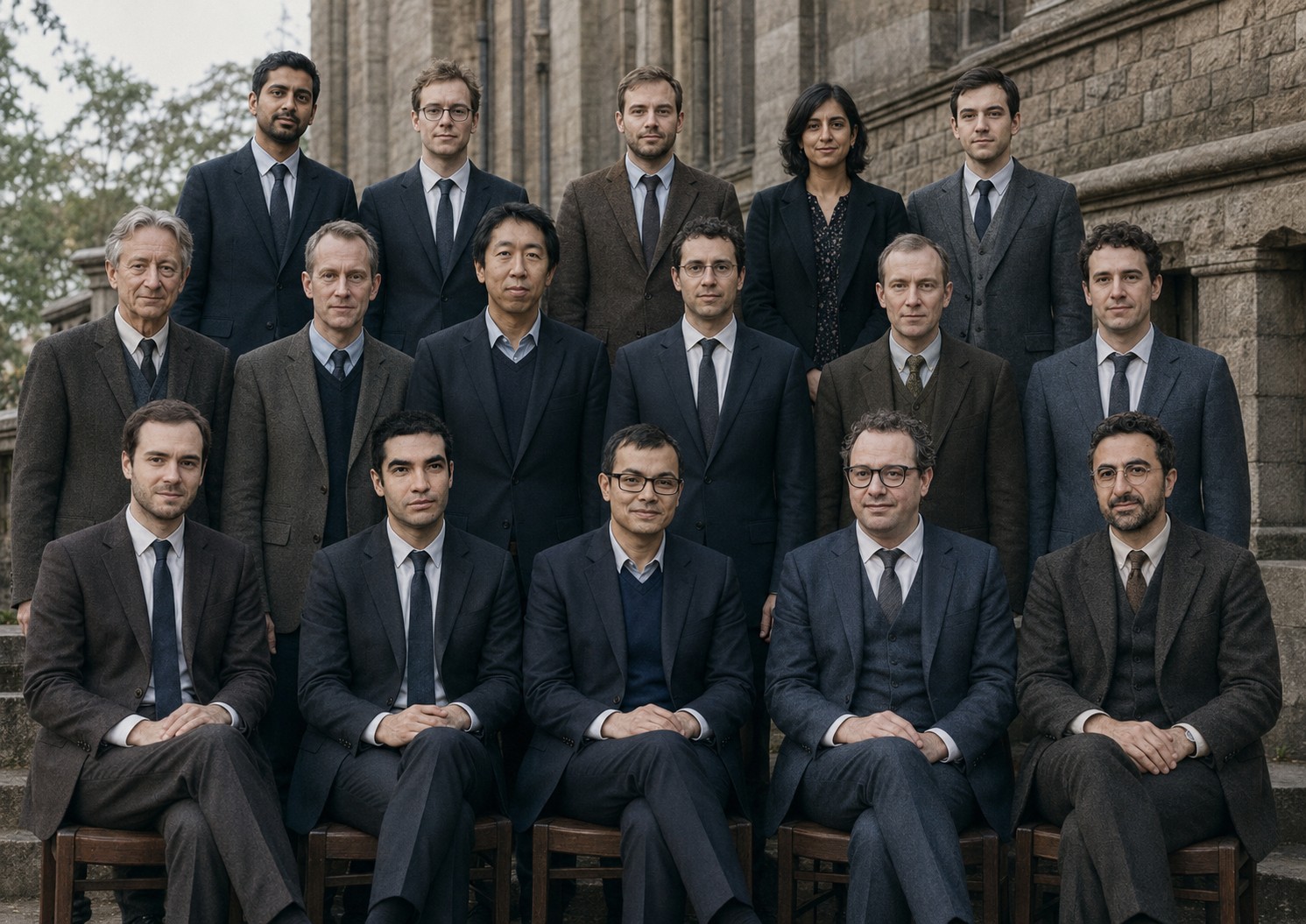
The first thing the exercise reveals is that no such photograph exists, and could not, because the modern structure is not a conference but a network that promptly fissioned. The transformer’s authors scattered to found or lead new labs — Cohere, Character.AI, and others. Sutskever helped build OpenAI and then left to start his own company; Amodei left OpenAI to found Anthropic; Suleyman went from DeepMind to Inflection to Microsoft; Karpathy passed through OpenAI and Tesla and back. The diaspora is the story, much as Fairchild’s departures were the story of Silicon Valley. The concentrated talent no longer holds still to be photographed; it moves through institutions, spins out new ones, and increasingly spills into independent researchers and open-source collectives working outside any single lab.
One connection between the two images is no longer merely rhetorical. In 2024 the Nobel Prize in Physics went to John Hopfield and Geoffrey Hinton for the foundations of machine learning with neural networks, and the Chemistry prize went, in part, to Demis Hassabis and John Jumper for using such networks to predict protein structure. Two figures who belong in any modern portrait already hold Nobels, in physics and chemistry — the same two prizes that saturate the 1927 picture. The descendants of the room are being honored with the room’s own awards.
The easy parallel is the wrong one. That version — quantum mechanics was mysterious and neural networks are mysterious too — flatters the analogy by blurring the kinds of mystery. Quantum mechanics had exact mathematical structure and made precise, repeatedly confirmed predictions; its puzzle was ontological, about what a well-defined theory meant for the nature of reality. The uncertainty around neural networks is of another kind: about their learned internal representations, about when and why they generalize, about how to evaluate them, and about their effects on the world. Mechanistic interpretability rhymes with the old search for a meaning behind a working formalism, but it is not a foundational crisis in physics, and “this generation’s Born rule” is a provocation rather than an equation.
The resemblance that does hold is narrower and more useful. Both episodes combined a new theoretical object — the wavefunction then, the trained network now — with rapidly improving tools, an unusual concentration of young talent, a few large institutional patrons willing to fund it, and a live argument about whether spectacular predictive success amounts to genuine understanding. That last question is the real through-line from Brussels to the present. In 1927 it read: does a formalism that predicts every spectral line tell us what an electron is? Today it reads: does a system that predicts the next word well enough to reason and converse understand anything? Neither field has settled its version, and in both the argument has done more work than the consensus.
One difference between the two settings is not flattering to ours, though it should not be drawn too sharply. Solvay was an invitation-only meeting, closed to the public — but its formal reports and discussions were published, converting part of an elite private gathering into a durable public record. The frontier labs of the 2020s — OpenAI, Google DeepMind, Anthropic, Meta, Microsoft Research, xAI — have all published influential work, and their openness varies by era, organization, and subject; the trend, though, as the stakes and the capital have risen, is toward disclosure only in a short “system card,” with the sharpest internal disagreements kept as trade secrets. The value of publishing was never that it settled things — the interpretation of quantum mechanics is unsettled to this day — but that the confusion became public, and so could be worked on by everyone able to see it. Whether a field can come to understand its own most powerful artifacts while the groups who understand them best compete and largely stay quiet is a real and open question.
Can the conditions be designed?
Which returns us to the question under the whole essay, and to a distinction the legend blurs. It is easy to say a meeting of thirty people reshaped civilization; it is truer, and more interesting, to be exact about what the meeting did and did not do. Cancel the 1927 conference and matrix mechanics, wave mechanics, and the transistor almost certainly still arrive — most of the foundational work was finished before the participants reached Brussels, and much of the decisive work came after. What the meeting did was compress a distributed revolution into a shared space: rival formalisms became mutually legible, weaknesses were exposed in days rather than years, and the disagreements entered the permanent record. A gathering of this kind changes history less by manufacturing ideas than by raising the rate at which existing ideas collide, combine, and harden into common infrastructure. The people reshaped the world, and so did the wider network they belonged to; the conference synchronized and recorded that network. That is a real effect, and a more modest one than the myth.
So: was Solvay designed, or did it simply happen? Some of both, and the proportion is the useful part.
The conditions were designed, and they are repeatable. A curator chose participants by contribution rather than rank. The size was kept small enough to keep the friction productive. The problem was single, shared, and genuinely open. The funding carried no product and no deadline, so the room could pursue understanding rather than advantage. And the format put rivals in one place and then published what they said, turning private insight into common property. None of that requires genius to arrange; it requires taste, money, and patience.
What could not be designed was the arrival of the ideas. You cannot schedule a Heisenberg or commission a Schrödinger equation. So the realistic aim is not to manufacture breakthroughs but to build the conditions in which breakthroughs, whenever they happen to come, are amplified rather than wasted. That is a modest-sounding goal and a powerful one.
The part most within deliberate control is the funding, and its source has shifted every generation while its function stayed the same. Solvay was private philanthropy. Bell Labs was the research dividend of a regulated monopoly, whose guaranteed telephone revenues insulated parts of its research program from immediate product pressure. The early internet and much early semiconductor work were government and defense. Fairchild’s formation and diaspora helped shape the Silicon Valley venture-capital model. Today’s frontier runs on venture money and the balance sheets of a few very large firms. Each era’s version of the room was paid for by that era’s surplus, spent by whoever was willing to fund the question rather than the product. The worry for our own moment is that the surplus is vast but aimed almost entirely at a product race, while the two institutions that best funded open, patient, published inquiry in the last century — the philanthropic convening and the monopoly lab with a mandate to publish — are both weakened. There is also a plainer point the 1927 picture makes unavoidable: twenty-eight men and one woman. Whatever else it records, it records a talent pool drawn from a sliver of the people who might have filled it. The contributors the age simply never looked for represent one of the largest recurring wastes in the history of ability, and widening that pool is not a decorative afterthought to building better rooms but among the highest-return moves available.
The photograph, again
Return to the picture on the steps. To almost anyone it is an old group portrait, indistinguishable from a thousand others. Read against what came after, it is closer to a diagram of much of the modern world, drawn before any of it existed. The people in it were not, in the moment, aware of doing anything grander than arguing about ψ; some contemporaries spoke as though the basic framework of physics was nearing completion. They were instead near the start of something, and the part of what they were doing that mattered most did not look like much: a small number of people who understood a hard problem deeply, disagreeing in one another’s presence, with much of the formal argument later published, and no machine anywhere in the frame.
That is the reason to keep an eye on the unglamorous version of the same scene now. Somewhere a comparable group is doing comparable work, and the record of it will be a phone photo at an offsite, or a list of names on a paper, long before anyone calls it historic. The people in it may not yet know what they have. Most of the rest of us will look past it, the way a passerby in 1927 would have walked past twenty-nine formally dressed academics without a second glance. The photographs that turn out to matter rarely announce themselves. The most we can do is get a little better at guessing which ones to keep.
Notes and sources
This essay follows mainstream history and physics while trying not to convert interpretation into settled fact — a temptation the subject invites. A few points where the popular telling misleads, corrected in the text:
- The Born rule fixes the probabilities of measurement outcomes; it does not by itself establish that ψ is physical, that particles lack positions before measurement, or that the world is indeterministic. Those are interpretive questions, still open.
- Bell’s theorem and the experiments that followed exclude local hidden-variable theories under standard assumptions, not determinism as such; the nonlocal, deterministic pilot-wave (de Broglie–Bohm) theory survives.
- Quantum mechanics was not “finished” in 1927: its nonrelativistic formalism had largely taken shape, but Dirac’s relativistic equation (1928), quantum electrodynamics, and quantum field theory came later.
- The vivid breakfast-by-breakfast Einstein–Bohr narrative rests largely on later recollection; the official 1927 proceedings record little of it, and the photon-box episode belongs to the 1930 council.
- Figure 2 is a synthetic illustration, not a photograph of any real meeting or team.
The conference, its venue, and its reconstruction
- Nobel Prize photo gallery, 1927 Solvay Conference — the original photograph and a full identification key for all twenty-nine participants. Figure 1 reproduces a later digital colorization of Benjamin Couprie’s original (colorization source unknown).
- Guido Bacciagaluppi & Antony Valentini, Quantum Theory at the Crossroads: Reconsidering the 1927 Solvay Conference (Cambridge University Press, 2009) — a full English translation of the proceedings and a corrective to the myth that the “Copenhagen interpretation” simply triumphed at Solvay.
- Institut International de Physique Solvay, Électrons et photons (Gauthier-Villars, 1928) — the official proceedings, with the reports by Bragg, Compton, de Broglie, Born & Heisenberg, and Schrödinger; International Solvay Institutes.
- On the Institut de Physiologie in the Parc Léopold as the venue: Université libre de Bruxelles institutional history.
Foundational figures and their prize-winning work (linked to the Nobel Prize record)
- Max Planck — the quantum of action (1900).
- Albert Einstein — light quanta (1905) and stimulated emission (1917), the laser’s theoretical root.
- Niels Bohr — the quantized atom (1913) and complementarity (the Como lecture, 1928).
- Louis de Broglie — matter waves (1924 thesis).
- Werner Heisenberg — matrix mechanics (1925) and the uncertainty relations (1927).
- Erwin Schrödinger and Paul Dirac — wave mechanics (1926) and the relativistic electron (1928).
- Max Born — the probability rule (1926; the |ψ|² correction added in a footnote in proof).
- Wolfgang Pauli — the exclusion principle (1925).
The debate and its experimental resolution
- Einstein to Born, 4 December 1926 (”…He does not play dice”), in The Born–Einstein Letters (Macmillan, 1971) — find at the Internet Archive.
- Niels Bohr, “Discussion with Einstein on Epistemological Problems in Atomic Physics,” in P. A. Schilpp, ed., Albert Einstein: Philosopher-Scientist (1949) — find at the Internet Archive.
- Einstein, Podolsky & Rosen, Physical Review 47, 777 (1935).
- J. S. Bell, “On the Einstein Podolsky Rosen Paradox,” Physics Physique Fizika 1, 195 (1964).
- David Bohm, Physical Review 85, 166 (1952) — the deterministic, explicitly nonlocal completion of de Broglie’s pilot wave.
- On quantum key distribution — BB84 uses nonorthogonal states, with entanglement-based protocols also possible: Shor & Preskill, Physical Review Letters 85, 441 (2000).
- The 2022 Nobel Prize in Physics (Aspect, Clauser, Zeilinger), on the exclusion of local hidden variables.
The compounding chain
- The transistor — Nobel Prize in Physics 1956; the integrated circuit — Nobel Prize in Physics 2000; and the Nobel history of twentieth-century physics on the quantum basis of band gaps and transistors.
- Claude Shannon, “A Mathematical Theory of Communication,” Bell System Technical Journal 27 (1948).
- Krizhevsky, Sutskever & Hinton, ImageNet Classification with Deep Convolutional Neural Networks (AlexNet, NeurIPS 2012); Vaswani et al., “Attention Is All You Need” (2017); Brown et al., “Language Models Are Few-Shot Learners” (GPT-3, 2020).
- On Fairchild and the venture-capital model: Computer History Museum, “The Next New Thing”. On the internet’s evolution beyond ARPANET: Internet Society, “Brief History of the Internet”.
- The 2024 Nobel Prizes: Physics — Hopfield & Hinton; Chemistry — Baker, Hassabis & Jumper.
Also cited
- Max Planck, Scientific Autobiography and Other Papers, trans. Frank Gaynor (Philosophical Library, 1949) — the passage that a new scientific truth “triumphs because its opponents eventually die.” Find at the Internet Archive.